The Sequential Blueprint for American Democratic Reform
A phased approach to implementing these American Ideas

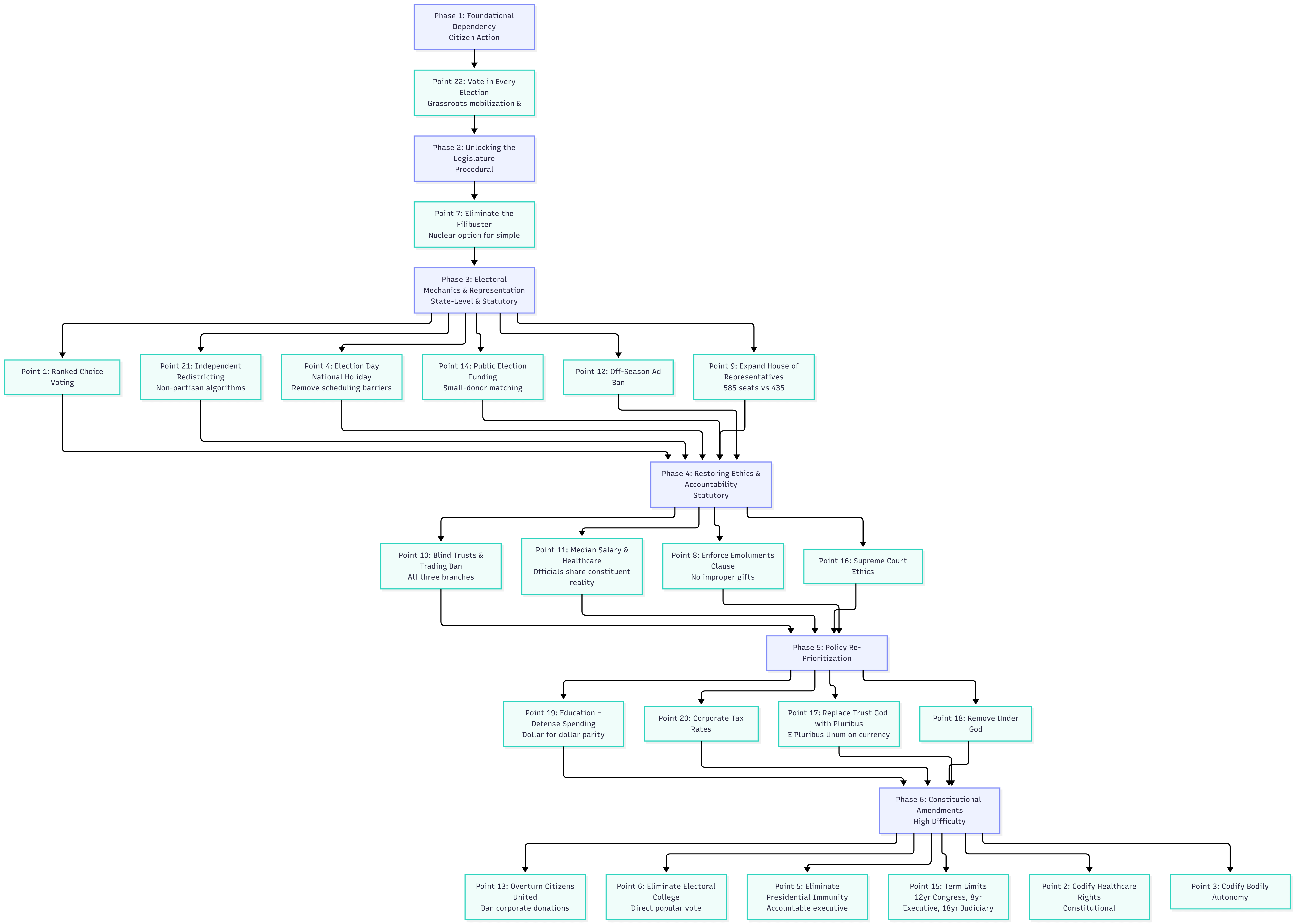
A subscriber recently asked, “Since trust in government and institutions seems so low right now, which of your proposed reforms do you think would be the best first step to help rebuild that trust?” I took a quick moment, composed a reply and utterly failed to adequately do their question justice. I need to rectify that. I can't expect a seemingly random compilation of ideas to spontaneously self-organize nor should I expect meaningful change without providing at least a suggested order of operations. To that end I submit the following sequential blueprint outlining a phased approach to implementing the proposed improvements within my American Ideas.
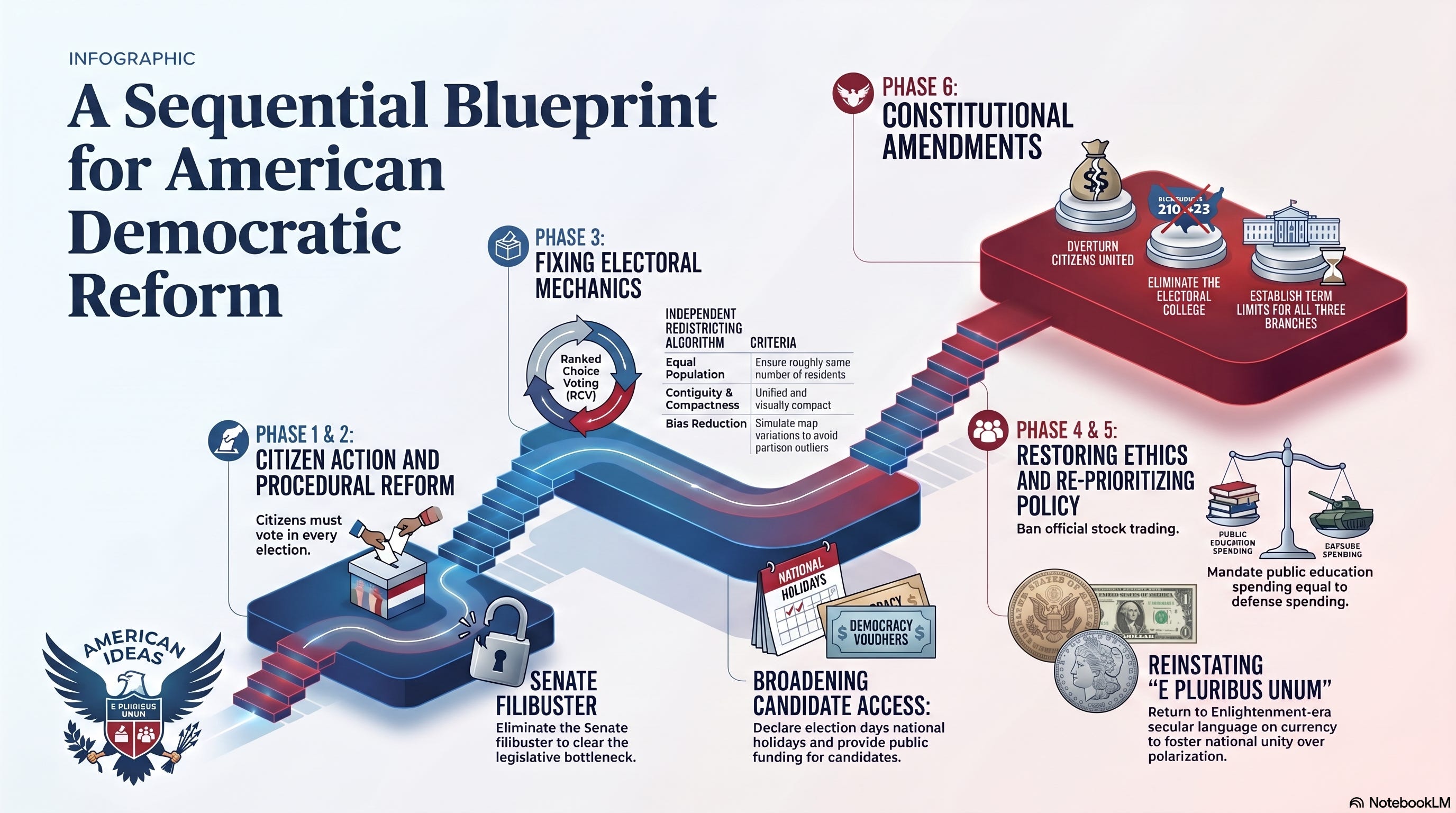
Phase 1: The Foundational Dependency (Citizen Action) To implement widespread structural change, the citizenry must first exert its power to install lawmakers willing to pass the reforms.
Point 22: Vote in every election, from your township to the national level. As established in our previous discussions, this is the foundational civic duty required to enact all other reforms. It is the highest-impact action with the lowest structural difficulty, relying entirely on grassroots mobilization and citizen engagement. Citizens can use decentralized organizing techniques like the “snowflake model” to build deep, relational commitments and rally voters.
Phase 2: Unlocking the Legislature (Procedural) Before any sweeping federal legislation can be passed, the existing bottleneck in the Senate must be cleared.
Point 7: Eliminate the filibuster. Currently, the 60-vote cloture rule causes extreme partisan gridlock. Eliminating it only requires a simple majority vote (the “nuclear option”) to establish a new Senate precedent. This is a crucial dependency for passing the rest of the statutory reforms without needing a supermajority.
Phase 3: Fixing Electoral Mechanics & Representation (State-Level & Statutory) With the filibuster removed, the focus must shift to high-impact electoral reforms that change who gets elected and who they are accountable to. Many of these can also be achieved at the state level via ballot initiatives, bypassing reluctant legislatures entirely.
Point 1: Adopt Ranked Choice Voting (RCV) universally. RCV reduces polarization, eliminates wasted votes, and diversifies the candidate pool. It can be advanced directly by citizens through state ballot initiatives.
Point 21: Set voting districts according to independent, impartial, and non-partisan algorithms. Handing map-drawing authority over to independent citizen redistricting commissions powered by algorithms neutralizes partisan gerrymandering (cracking and packing) and ensures elections reflect the will of the people.
Point 4: Declare election days national holidays. This addresses the reality that “being too busy” or having conflicting schedules is a top reason registered voters fail to turn out.
Point 14: Provide minimum public funding for local, state, and federal elections. Implementing small-donor matching or democracy vouchers reduces reliance on wealthy elites, diversifies the candidate pool, and allows candidates to spend time governing rather than fundraising.
Point 12: No campaign advertising during the “off season”. Establishing defined campaign periods limits the unregulated flood of third-party spending between elections and cures voter fatigue.
Point 9: Increase the number of representatives in Congress. As previously discussed, capping the House at 435 seats ballooned the average district to 770,000 constituents. Expanding the House (e.g., to 585 seats) dramatically increases representation and lowers the cost of campaigning. This is a high-impact reform that requires only a simple federal statute to pass.
Phase 4: Restoring Ethics & Accountability (Statutory) Once the legislature accurately represents the people and is insulated from extreme wealth, it must aggressively enforce internal ethics.
Point 10: Legislate blind trusts and ban stock trading for all three branches of government. This strictly prevents officials from managing their portfolios while making policy or judicial decisions, eliminating inherent conflicts of interest.
Point 11: Limit the healthcare options and salaries of elected officials to the median of their districts. This forces politicians to share the lived economic and medical realities of their constituents, creating a direct incentive to improve local conditions.
Point 8: Enforce the emoluments clause. Ensuring elected officials do not accept improper gifts or financial benefits guarantees they serve the public interest.
Point 16: Reform the Supreme Court (ethics standards). Implementing an enforceable code of conduct curbs abuses, such as justices accepting luxury gifts, and restores public trust in the judiciary.
Phase 5: Policy Re-Prioritization (Statutory) With an accountable, highly functioning government in place, the nation can enact sweeping legislative changes to budget priorities and national identity.
Point 19: Reprioritize and mandate public Education spending equal to Defense, dollar for dollar. Reallocating hundreds of billions away from the military-industrial complex toward public education addresses the massive 13-to-1 spending disparity and shifts the nation’s priorities.
Point 20: Return corporate tax rates to pre-Reagan era. Forcing massive corporations to pay their fair share and closing loopholes encourages companies to re-invest their profits into their workforce and domestic infrastructure.
Point 17: Remove “In God We Trust” from our money and re-implement “E Pluribus Unum.”
Point 18: Remove “under God” from the Pledge of Allegiance. Reverting to Enlightenment-era, secular language defends the separation of church and state and fosters national unity over Cold War-era polarization.
Phase 6: The Constitutional Amendments (High Difficulty) The most difficult reforms require a Constitutional Amendment (two-thirds majority in Congress and ratification by three-fourths of the states). These are placed last because they are entirely dependent on the success of the previous phases; a hyper-polarized, gerrymandered Congress funded by dark money would never pass them.
Point 13: Overturn Citizens United, remove corporate “rights,” and eliminate corporate donations. Because the Supreme Court treats money as speech and corporations as people, a constitutional amendment is the only permanent way to overcome the ruling and ban corporate money.
Point 6: Eliminate the Electoral College. Shifting to a direct popular vote ensures every voter’s voice is equal and prevents presidents from winning without the popular vote.
Point 5: Eliminate Presidential Immunity. Restoring the Founders’ vision of an accountable executive ensures that no president is above the law.
Point 15: Reasonable term limits for all three branches. Establishing a 12-year maximum for Congress, an 8-year limit for the Executive, and staggered 18-year terms for the Supreme Court requires sweeping constitutional overhauls to break up entrenched power.
Point 2: Codify medical and healthcare rights constitutionally.
Point 3: Codify women’s bodily autonomy constitutionally. Cementing healthcare as a fundamental human right protects personal liberty from shifting Supreme Court interpretations and state-level bans.
E Pluribus Unum